
Resource planning that actually works
From task lists to capacity foresight: what it takes to implement resource planning successfully, when your organisation needs it, and how AI is changing the game.
By Jan Jensen, Sales & Product Director, VOLI · 12 pages · PDF
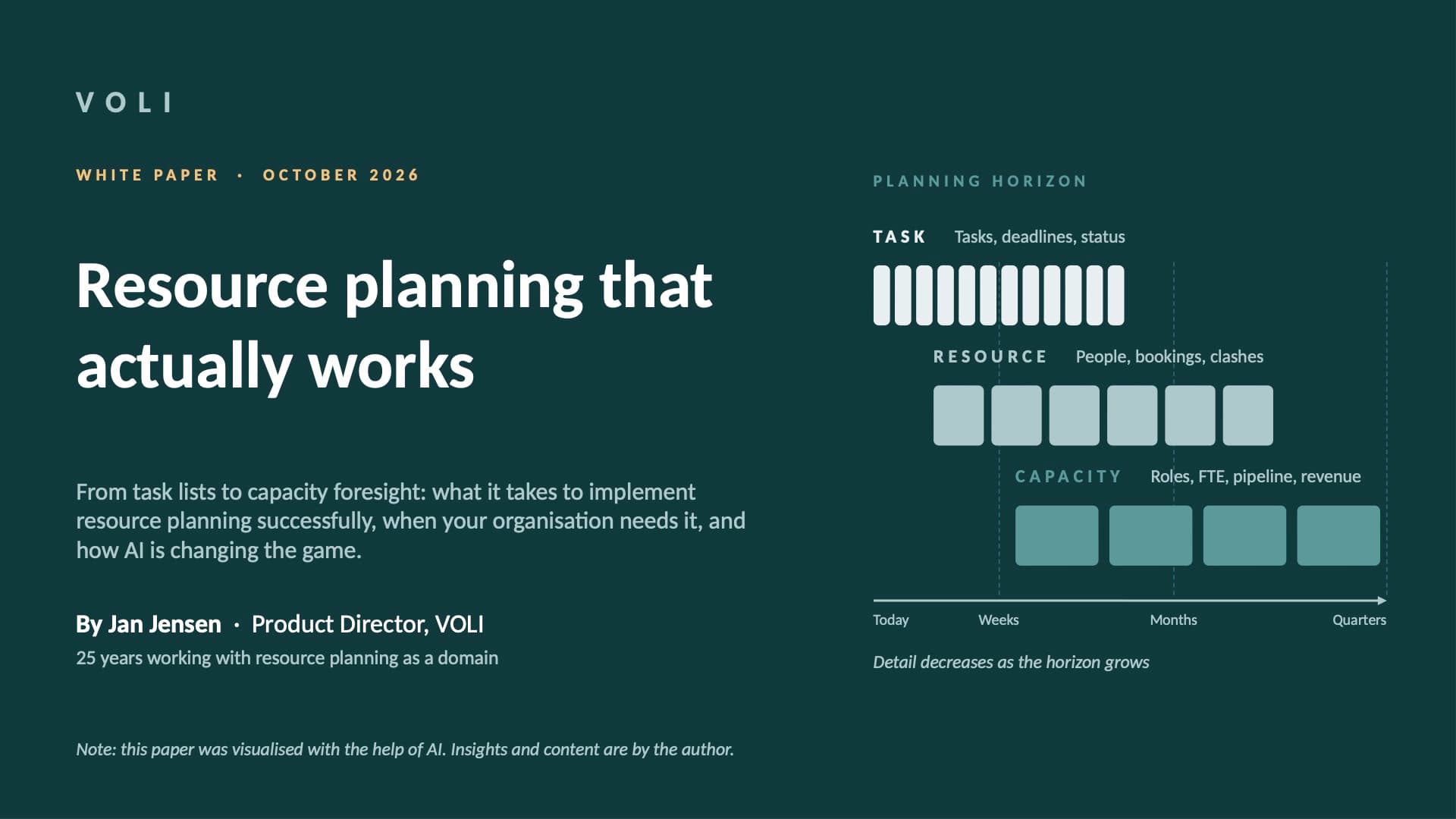
In professional services, time is the product, and it cannot be stored. An hour that is not planned today cannot be sold tomorrow. This white paper is about getting resource planning right: when you need it, what makes it work, and where AI fits in. Here is what it covers.
When does a company need resource planning?
Coordination grows faster than headcount: 10 people have 45 possible links between them, 100 people have 4,950.
- 1–15 people: Everyone knows everything. A task tool and a weekly stand-up are enough.
- 15–40 people: The first conflicts over shared experts. Spreadsheets appear, and resource planning starts to pay off.
- 40–150 people: Many teams and competing projects. Structured resource planning and a resource manager role become essential.
- 150+ people: Portfolio and hiring decisions. Capacity planning is tied to pipeline, recruitment and finance.
Headcount is not the only signal. Ten or more projects at once, specialists shared across teams, billable utilisation targets, sales committing without checking availability, and overtime alongside idle time all point the same way.
Six fundamentals of successful resource planning
- 01Keep it simple. Plan hours per person per week, not minutes per task. Detail you cannot maintain destroys trust in the plan.
- 02Clear ownership. Explicit roles for who requests, who allocates and who resolves conflicts, with an agreed escalation path.
- 03One source of truth. Plans, bookings, actuals and financials in one flow, linked to the ERP rather than kept in parallel spreadsheets.
- 04A fixed planning rhythm. A weekly staffing day, a monthly capacity and revenue review, and a quarterly outlook. The cadence is the system.
- 05Skills and availability data. Current skill profiles, absence and contract data, so people are staffed by competence rather than memory.
- 06Plan pipeline and revenue. Plan opportunities alongside projects and forecast revenue, not just resources.
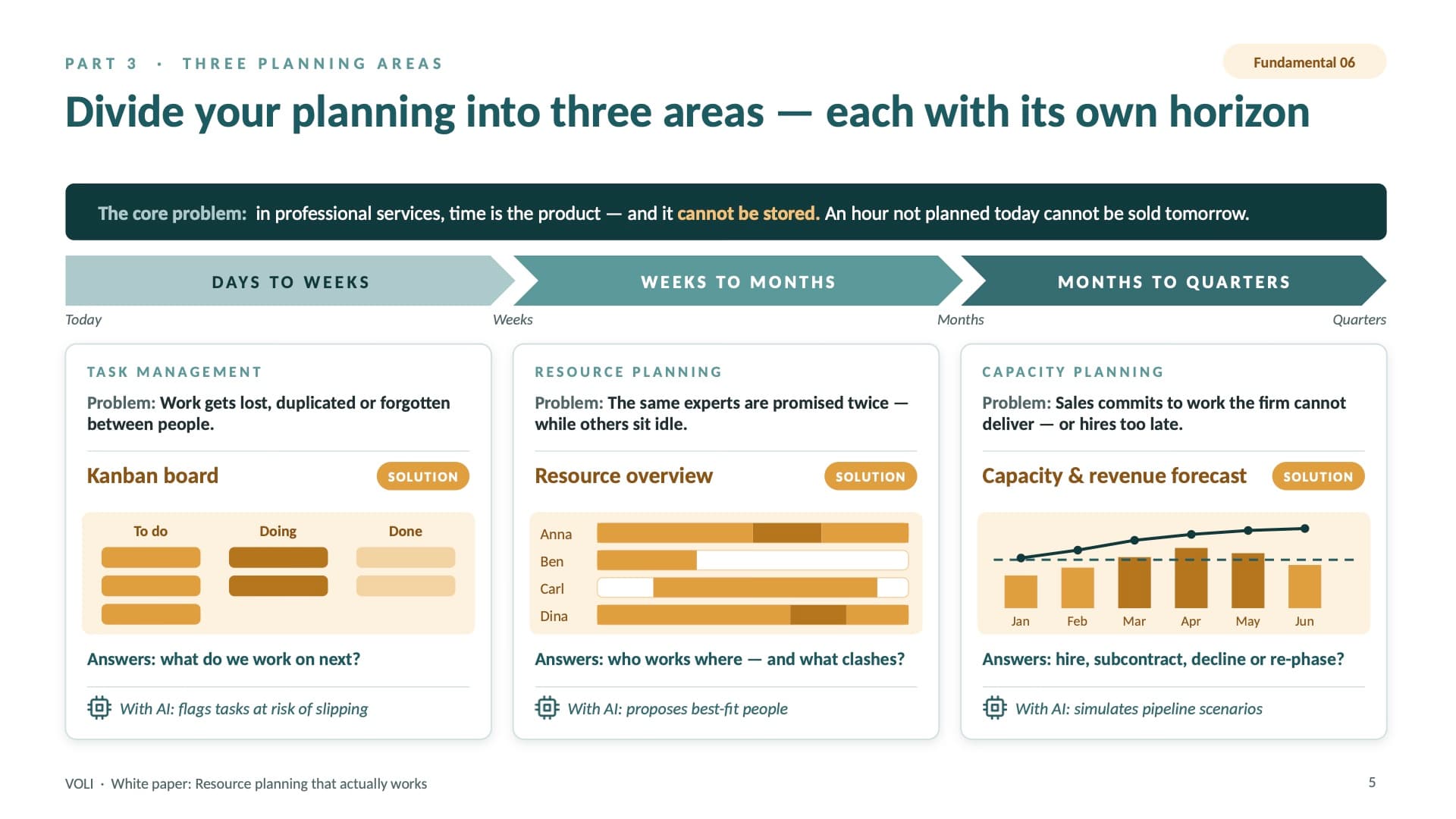
Three planning areas, each with its own horizon
Task management, resource planning and capacity planning answer different questions, over different time spans, and belong to different people. Mixing them up is one of the most common reasons planning stops being trusted.
Days to weeks
Task management
What do we work on next?
Weeks to months
Resource planning
Who works where, and what clashes?
Months to quarters
Capacity planning
Hire, subcontract, decline or re-phase?
AI changes how we plan, not who decides
AI can draft work breakdowns, answer “who has Power BI skills and 20 free hours next month?” in seconds, and simulate what happens if you win both bids. It cannot set priorities between clients, look after people's development or take responsibility towards customers. And it only plans as well as the data it stands on, which is why current skills, availability and bookings come first.
Agree the process first, then configure the software
1. Diagnose · 2–4 weeks
Name the painful question; map roles, data and tools.
2. Pilot as process design · 8 weeks
Agree the planning rhythm and roles in one unit.
3. Configure the solution · 2–6 weeks
Set up standard software to fit the agreed process.
4. Roll out in waves · 6–12 weeks
Units book four weeks ahead; spreadsheets are retired.
5. Embed and improve · Ongoing
Add opportunities, revenue forecasts and AI.
Starting with the tool gives a fast go-live, and then the spreadsheets come back. Starting with the process is slower at first, but adoption keeps growing.
Where are you today?
The paper ends with a five-step maturity model, from reactive (staffing when someone shouts) to business-driven (capacity steers sales, hiring and margin), and three concrete places to start.
Read the full white paper
12 pages, free, no sign-up.
Want to talk about resource planning?
Book a 30-minute call with VOLI. We go through how you plan today and what would make the biggest difference.
Book a call